Toyota Airport Navigation
UX Research
Project Overview
UX Research to promote mobility for all. Multi-university team researched and developed two prototypes of wearable devices to support wayfinding in airports for users with a range of disabilities.
PROJECT
TASK
MY ROLE
TEAM
DURATION
University research
Research and develop a prototype to support wayfinding in airports for people with a range of disabilities
Research Assistant
User Personas
Semi-structured Interviews
Qualitative Coding
Storyboards
Prototypes
UMBC
UCI
2019 - 2020
Project
As part of the INsite Lab led by Dr. Stacy Branham at UC Irvine, I had the opportunity to work on this project as a research assistant from 2019 to 2020. A multi-university team including University of Maryland, Baltimore County and in partnership with Toyota Motor North America. The Toyota Navigation project aims to promote mobility for all and support wayfinding for users with a range of disabilities.
User Research
Semi-structured Interviews
27 participants interviewed
5 ability-based identities represented:

We conducted 27 semi-structured interviews with participants of varying ages and disabilities to gain an understanding of their navigational preferences and current technology uses.
Important Navigational Cues
- Crowded Areas
- Carpeted Areas
- Stairs
- Ramps
- Seasonal Challenges
- Construction
- Signage
- Landmarks
User Personas
Themes and patterns were found after coding our interviews which allowed us to create fictional characters to represent a range of user types. These representations allowed us to better understand the ability-based identities we seek to support. From these patterns we generated four categorical preferences, figure 1. These preferences allowed us to draw inspiration from the Myers-Briggs personality types, generating 16 navigation personalities. From these 16 groups, we narrowed 4 groups that were the most common amongst participants, see figure 2.

Fig. 1, Categorical Preferences generated from themes and patterns found in user interviews.

Fig.2, One of the 4 navigation personalities inspired by Myers-Briggs personality types.

Fig.3, One of our final 4 User personas, representing TSFEf. Omar is a 67 year old policy consultant from Maryland who prefers technological assistance with spontaneous routes, is familiar with technology and prefers an efficient experience for navigation.
Design Spaces
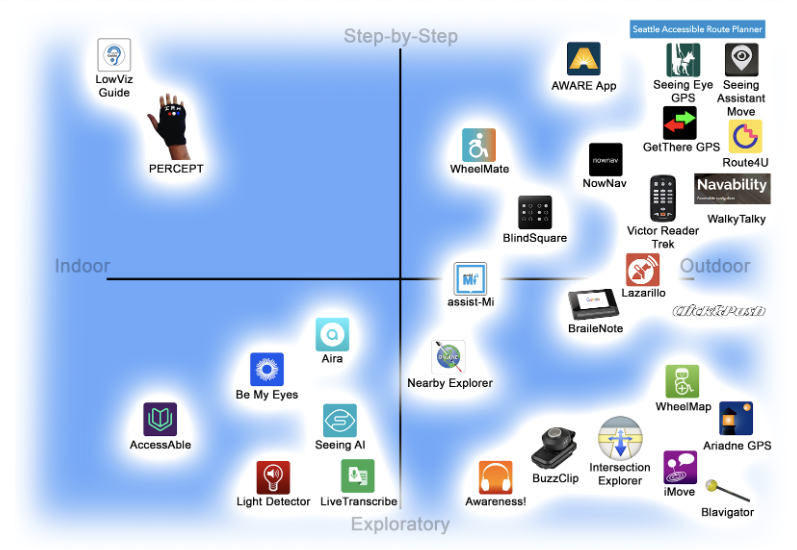
We performed a competitive analysis, a strategy used for researching major competitors to evaluate technologies on specific criteria. We sought to gain insight on how current technologies are meeting the needs of users. We found that ~50% of products support exploratory wayfinding, but they do not leverage multimodality.

Prototypes
Sketches were developed to test and validate versions of our product. We decided on 4 prototype models that included multiple bands: velcro, silicone, clasp/buckle, and a slap band (inspired by the slap bracelet from 1983; layered, flexible spring bands sealed within silicone or plastic). These set of 4 prototype bands were sent to participants to evaluate and conduct follow-up interviews.

Prototype sketches by Mayra Cortez
Storyboard
To support our prototypes, scenarios of users navigating an airport while using our SLAPP Band prototype were sketched. Below is a visually impaired person arriving to an airport, the user uses the SLAPP Band to inquire about the gates around them and for directions to the nearest restroom and surrounding restaurants.


Storyboard by Mayra Cortez